
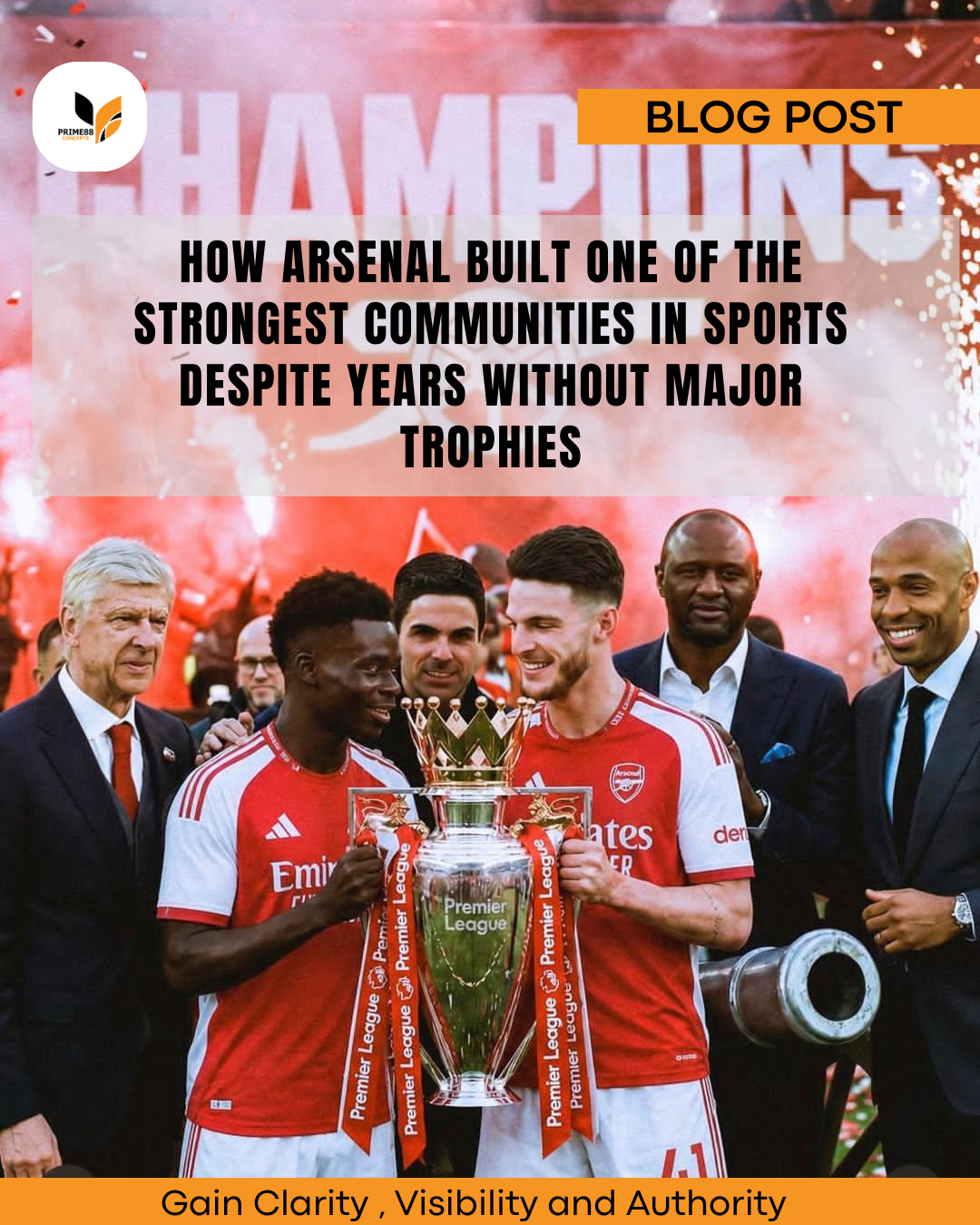

Every football season comes with its own rhythm of celebration, criticism, debate, and global conversation, and Arsenal’s recent success has once again placed the club firmly at the centre of attention, with fans reflecting on how far the team has come under Mikel Arteta, yet beyond the immediate football headlines and the excitement of results, there is a deeper and more interesting story unfolding beneath the surface, one that speaks less about tactics or trophies and more about branding, PR, leadership, and identity formation over time.
Because when you look closely at Arsenal’s journey, what stands out is not simply the moments of victory on the pitch, but the consistency of emotional connection the club has maintained with its global fanbase even through years where major silverware was not part of the narrative, and that level of loyalty begins to raise a more important question about how communities are actually built and sustained in modern sport.
And the answer does not sit in performance alone, but in something far more layered in the way identity was formed, how leadership shaped perception, and how culture slowly became something fans didn’t just observe, but belonged to.
Because Arsenal, at its core, has never really been just a football club.
Arsenal’s Identity Was Built Long Before Recent Success
The story of Arsenal begins in its origins at Woolwich, where the club was formed in 1886 by workers at the Royal Arsenal armament factory.
This origin is significant because it immediately positioned the club within a working-class identity, one rooted in collective belonging, shared struggle, and community pride rather than elite sporting ambition.
As the club evolved and eventually relocated to North London, this foundational identity did not disappear. Instead, it adapted and expanded, becoming more sophisticated but still emotionally anchored in the idea of “belonging to something greater than oneself.”
Over time, Arsenal became more than a football team. It became a cultural institution. And cultural institutions do not rely solely on performance to maintain loyalty, they rely on meaning.
The Wenger Era: When Philosophy Became the Brand
One of the most significant transformations in Arsenal’s history came with the arrival of Arsène Wenger, a managerial figure whose influence extended far beyond tactics or match outcomes.
Wenger’s era marked a structural and philosophical shift in English football at the time. Before his arrival, Arsenal, like many English clubs, largely relied on domestic players and traditional approaches to training, nutrition, and preparation.
Wenger introduced a fundamentally different worldview. He brought in a more international recruitment strategy, significantly increasing the presence of French and foreign players within the squad. This shift alone altered the cultural makeup of the team.
However, his influence went much deeper than recruitment. Wenger changed how players lived and performed. He restructured their diets, introduced scientific approaches to fitness and recovery, and enforced higher levels of professionalism and discipline. These changes were not merely operational improvements, they represented a new philosophy of football entirely.
And that philosophy became visible on the pitch. Arsenal developed a distinct way of playing that separated them from other clubs. The style was fluid, technical, and aesthetically recognizable. This “way of playing” became part of the club’s identity.
At this point, Arsenal was no longer just defined by wins and losses. It was defined by philosophy. And philosophy, once established, becomes brand identity.
When Leadership Becomes Identity: The Wenger Effect
Over time, Arsène Wenger became more than a manager in the eyes of many supporters.
He became an emotional symbol of the club itself. For a significant number of fans, Wenger represented stability, continuity, and long-term vision. His longevity at the club reinforced a sense of trust that extended beyond tactical decisions.
In many ways, supporters began to associate Wenger with the very essence of Arsenal.
There was even a psychological layer to this connection, the name “Arsène” bearing a striking resemblance to “Arsenal,” which, while coincidental, reinforced the emotional association for many fans.
As a result, Wenger’s identity and the club’s identity became deeply intertwined. And when leadership becomes symbolic in this way, it stops being purely functional. It becomes personal.
Fans begin to relate to the club through the emotional image of its leader, not just its performance.
This is a critical moment in any brand’s evolution,when leadership becomes part of the brand narrative itself.
When Leadership and Culture No Longer Feel Aligned
After Arsène Wenger’s long tenure came to an end, Arsenal entered a transitional period that exposed how deeply identity and emotional continuity influence perception.
When Unai Emery was appointed, the club entered a phase of tactical and cultural adjustment.
However, beyond technical or performance-based evaluation, what became evident among supporters was a sense of emotional and cultural misalignment.
This was not simply about whether the team was winning or losing. It was about whether the club still felt like Arsenal.
Under Emery, the philosophy, communication style, and on-field identity appeared different from what fans had grown accustomed to over many years.
And this is where a crucial branding principle emerges: When an institution’s identity shifts too quickly or feels unfamiliar, audiences do not process it analytically, they experience it emotionally.
And emotionally, familiarity matters as much as performance.
This is why transitions in strongly established brands are often complex, not because change is inherently negative, but because identity continuity has been disrupted.
The Arteta Effect: Why Familiarity Rebuilt Trust
The appointment of Mikel Arteta marked a different kind of transition in Arsenal’s modern history.
Unlike previous managerial changes, Arteta’s arrival was met with a more patient and emotionally open reception from supporters.
This response was not solely based on results, especially in the early stages of his tenure, but rather on something more fundamental.
Arteta was not perceived as an external figure imposed upon the club. He was seen as someone who already belonged to its internal culture. Having previously played for Arsenal, he understood the identity, expectations, and emotional language of the club.
This created a sense of continuity rather than disruption.
Even during periods when performance was inconsistent, there remained a belief among many fans that the club’s identity was being restored rather than replaced.
This distinction is essential.
Because in emotionally invested communities, people are often more willing to endure difficulty when they believe the underlying identity remains intact.
Arteta’s role, therefore, extends beyond tactical rebuilding.
It represents cultural reconstruction, a return to a familiar sense of “what Arsenal feels like.”
And according to our CEO, Folasade Abimbola, “Arsenal’s magic is really in sort of brand & values the club has built over time and there’s something for us to learn from it”
What Arsenal Teaches Us About PR, and Personal Branding
Arsenal’s story is not simply a football narrative. It is a long-term case study in identity formation, emotional perception, leadership influence, and cultural continuity.
One of the most important lessons embedded within this history is that perception often outlives performance. Even during extended periods without major trophies, Arsenal remained globally relevant because its identity had already been firmly established in the collective imagination of its audience.
Supporters were not merely attached to results.They were attached to meaning, identity, philosophy, and belonging. This is where branding becomes most powerful.
Strong brands are not sustained by visibility alone or by temporary success. They are sustained by consistency, emotional storytelling, recognizable leadership identity, and long-term psychological association.
Leadership plays a particularly important role in this process. Different eras of Arsenal demonstrate how leadership style and cultural alignment shape audience interpretation. When leadership feels aligned with existing identity, trust is reinforced. When it feels misaligned, emotional distance naturally emerges.
And this principle extends far beyond football.
It applies to organizations, businesses, founders, content creators, and individuals building personal brands.
Because at every level of influence, branding ultimately operates through the same foundational forces: identity, consistency, perception, and emotional connection.
People do not remain connected to isolated achievements. They remain connected to what feels familiar, meaningful, and emotionally consistent over time.
Arsenal, in its entirety, simply demonstrates what happens when those forces are developed, sustained, and inherited across generations.